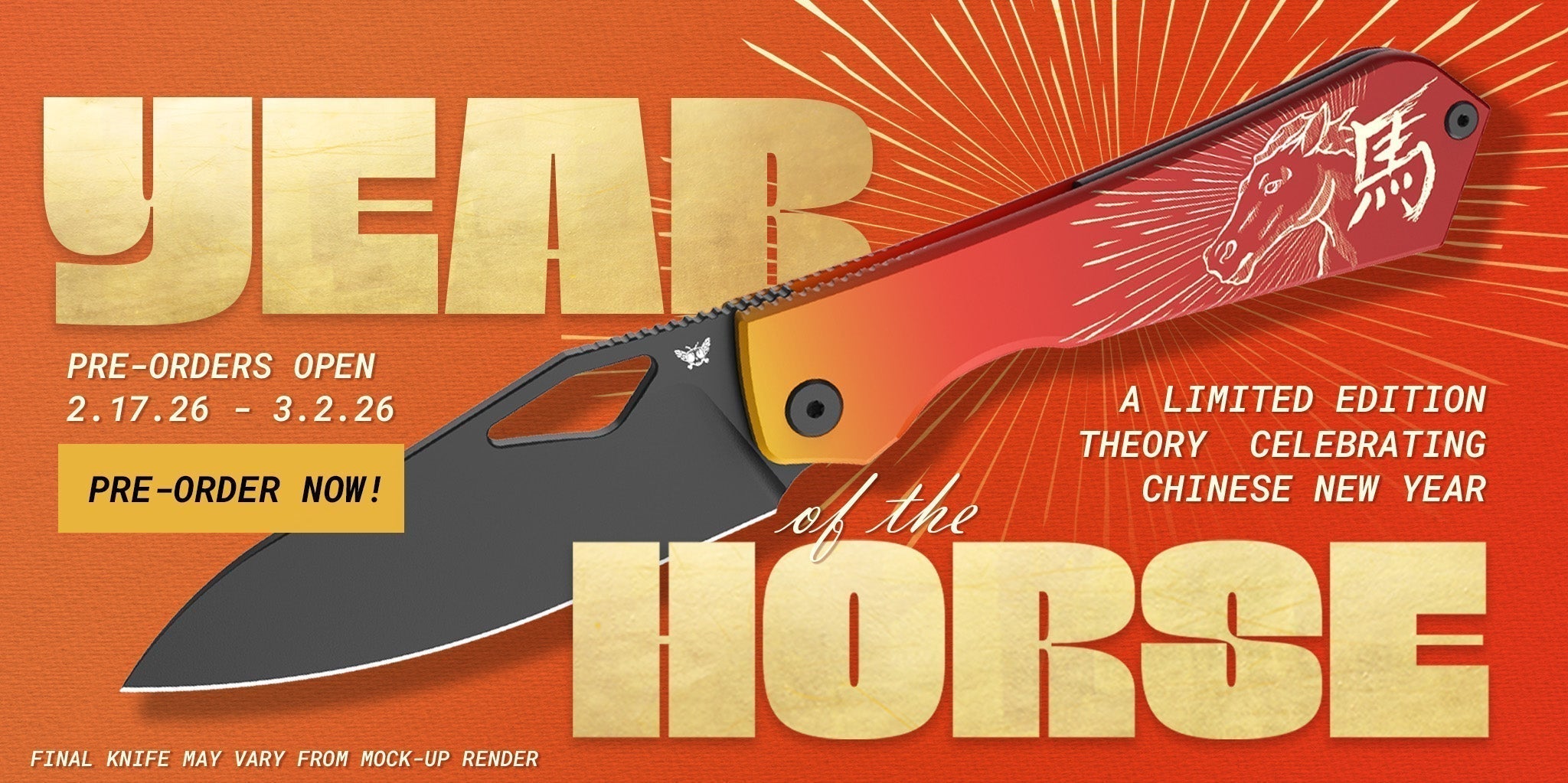

This year, we’re back with a new knife featuring a brand-new design that’s available for preorder! Get it HERE and keep reading for the full story.
We’re charging into 2026, Year of the Fire Horse, and we’re celebrating Chinese New Year in Flytanium style. Let’s get into it.
What is Chinese New Year?
Hi, I’m Annissa and I’m going to walk you through Chinese culture, my experiences, and why Chinese New Year is so significant.
Last year, we talked about the Lunar New Year — an event celebrated across many countries and cultures based on lunar or lunar-solar calendars.
We wanted to focus on Chinese New Year a little bit more this year. Chinese New Year doesn’t occur on a set date, but it often happens on the second New Moon after the Winter Equinox. Chinese New Year usually occurs between Late January and February. This year in 2026, Chinese New Year falls on February 17.
As a kid, I looked forward to three exciting things that only happened during Chinese New Year: we got to wear cool clothes, we received Hong Bao, and we stayed up late celebrating.
 Cool Clothes: In our closets, there were special clothing we couldn’t wear to school or church. The shiny-patterned, silk-glimmered outfits hung patiently until it was finally Chinese New Year.
When it was finally time, we would run to our closets and find the clothes our Popo sent us from China. My sister and I wore qipao (pronounced: chee-pow), which are long patterned silk dresses, and my brother wore his tangzhuang (pronounced: tahng-jwahng), a patterned silk suit. Our mom would always need to help us with the frog buttons, but once they were on, I remember sitting and tracing the brocade patterns on the cloth, drawn in by the colors and textures.

Hong Bao: After we all got dressed, we’d make our way to a restaurant or a friend’s house. My mom would coach us on how to wish people a happy new year, “xin nian kuai le” (pronounced: shin nyen kwhy luh), and reminded us to say “xie xie” meaning “thank you” (pronounced: shyeh-shyeh) to anyone who gave us a lucky red packet.
These envelopes, known as Hong Bao or Lai See (pronounced: hung-bow or lay-see), are a bright red color symbolizing happiness and good fortune. Inside would be a cash gift, often in smaller amounts from acquaintances or even $20 from close family friends.
It’s impolite to immediately open your hong bao, so our parents held on to them for the night. We’d sit and eat dinner, the adults catching up and reminiscing while we played with the other kids.

Staying Up Late: We knew once dinner was over, it was only a matter of time before the main event. If we were down in Chinatown, we’d anxiously wait until we heard the drums and chimes heralding the lion-costumed dancers who were entering the plaza. The lions were mesmerizing, going from a low bow to a tall, proud stance. Their eyes would blink, mouths open, and we’d always hope they would come up to us, and we could place hong bao in their mouths.
At home, we’d stay up to light fireworks, or in my case, hold a sparkler and watch other people light fireworks. My mom told us about Nian (pronounced: nee-an) — a beast from folklore that showed up on New Years Eve and ate plants, animals, and even naughty children like ourselves.
She taught us that wearing red, making loud noises, and shining bright lights kept misfortune and evil spirits like Nian away so we could enter the new year brimming with hope, prosperity, and good fortune. As a kid, that meant banging on a pot with a spoon while fireworks went off to make extra, EXTRA sure that you scared all the evil spirits away. 10/10 — highly recommend.

Animal Zodiac & Mythology
One of my earliest memories I have is learning about the different animals in the Chinese Zodiac, and how they earned their places.
The Jade Emperor held a race, open to all animals of his kingdom. The race was simple. The first 12 animals who passed through the Heavenly Gate would receive a year named after them.
The racecourse took participants through a strong and mighty river, causing contestants to use all of their wit, strength, and other means they had to get across.
The first animals that crossed the line were the Rat and the Ox. They were actually best friends, so this made a lot of sense. The Rat rode on the Ox’s head while the Ox easily pushed through the currents of the river. At the finish line, the Rat jumped off, immediately taking first place with the Ox following closely to take second. They’re still besties to this day.
Next came the Tiger. The mighty river pushed the Tiger downstream, but it swam hard and clawed its way across to claim spot number three.
Then they heard a thumping noise... it was the Rabbit. The Rabbit had jumped from stone to stone until there were none left. Looking like it had no place to go, it saw some driftwood. It leaped on top and eventually made it to shore and on through the Heavenly Gate in fourth place.
Confused, they then saw the Dragon about to take fifth place. Why didn’t the Dragon win by a mile? It can fly after all. However, as it was racing over, it saw a village in need of rain and water. It helped them out and, as it got back on track, it also noticed that the Rabbit needed help. It gave a big breath of air to push the Rabbit and its piece of wood across the river. The Jade Emperor admired this act of generosity.
Out in the distance, they all heard a strong galloping noise getting louder. The Horse was thundering, charging to the Heavenly Gate... only to skid to a quick halt. The Snake was wrapped around its leg! The Snake jumped off, scaring the Horse in the process, and taking spot number six. The Horse quickly followed and took spot number seven.
Here’s come the trio — the Ram, the Monkey, and the Rooster. These three teamed up to cross the river together, using their skills, wits, and strengths to their collective advantage. The Jade Emperor awarded them eighth, ninth, and 10th place.
Barking was then heard. It was the Dog excitedly playing in the water. He forgot that there was a race going on but he eventually made it and claimed spot number 11.
Who would take 12th place? Slowly emerging was the Pig. It didn’t seem to be in a huge hurry. The Pig had stopped to grab a hearty lunch. Then a nice, long nap from all the walking and eating. And it got distracted by a bunch of other things on its to-do list. Despite the Pig’s easygoing nature, it finally passed through the Heavenly Gate and became the 12th animal in the Chinese Zodiac.
This is just one version of the story. There are many iterations — one where the Rat betrays the Cat by not waking him up to go to the Emperor’s palace. In another, the Rat, the Cat, and the Ox are traveling together, and the Rat pushes the Cat into the river. The Rat doesn’t seem to like the Cat...
There are even regional and cultural differences with this story. To name a few — in Malaysia, the Rabbit is replaced by the Mousedeer, and the Pig with a Tortoise. In Japan, the Pig is replaced by a Boar, a wilder version of the animal.
I was born in the year of the Rabbit, and like a rabbit, I can be quick, almost to a fault at times. Rabbits are also known for being lucky, hopeful, and kind, and I hope I share those traits as well.
You can learn more about the Chinese Zodiac, their related elements, and what animal corresponds to your birth year in our Chinese Zodiac Guide HERE.
My Aunt’s Request
When it comes to the Year of the Horse, you can expect to see a lot of movement. Horses are well-liked, confident, intelligent, and tenacious. Sure, they might lose steam on an impulsive idea, but they really dig their hooves in on things they care about. Some people call it stubborn, but I call it tenacity.
My aunt is the perfect example of someone born in the Year of the Horse. She’s moved across the world countless times, from Malaysia to the United States Mainland, and from China to Hawaii. Even now, she’s currently traveling across the world. She’s one of the smartest people I know, commands a room, is incredibly kind and generous, and has iron morals she doesn’t compromise on.
My aunt actually asked me last year if I could make a knife with a horse on it. I sketched out a couple ideas and looked into the logistics. Ultimately, the timeline didn’t work out.
That would soon change as Flytanium was brainstorming future knife ideas for the year 2026. I wanted to see if I could bring my aunt’s request to life. I proposed we do another Lunar New Year design, and the team was immediately and fully on board. We found the perfect canvas to put this on — with the Theory.
With these plans, I set out to make this special knife an improvement on the first, with extra care and meaning added into the entirety of the design.
More Than Fireworks — Etiquette + Traditions
With each passing year, Chinese New Year became more meaningful. I began to notice what foods we always ate, like steamed fish and nian gao cake (pronounced: nyen gaoww). My mom taught me how prep food with her in the kitchen, like folding dumplings and rolling out tangyuan rice balls (pronounced: tahng-ywen).
Each year, my mom taught me more about her traditions. Not to flip the fish over and leave some extra, where we put certain decorations and their proper orientation.
I learned how to greet my elders with proper etiquette and what gifts were appropriate for the New Year, something that’s taken me far when meeting family and friends and even when hosting our Chinese manufacturers that occasionally visit Flytanium in Utah, USA.

So when it came to designing the Chinese New Year Theory knife, I knew the details mattered. I brought in my hong bao, red packets, so we could match the red and gold finish on the knife. I tried out many different color combinations. Would orange and green, like a tangerine, do justice for this?
I knew that this Theory needed these two core elements: a horse with the traditional Chinese character “ma” (meaning “horse”) in a brushwork inspired style as well as a fiery red and gold body.
To do this, I had to go all the way back to my high school days — when I first started studying Chinese with purpose. That’s where I started learning how to read and write characters and where I also really, REALLY got into horses.

Ma Little Pony — The Process
In a funny way this almost comes full circle, when I was first getting into art I was a sucker for drawing horses and dragons. And honestly, the muscle memory to churn out a solid horse shape is still there.
This was also the time when I started learning Chinese in high school, so one side of the paper would be my Chinese homework and the other side would be a bunch of horses, dui bu qi, lu laoshi (pronounced: dway-boo-chee, laow-sheh) — “I'm sorry, teacher Lu.” :)
When it came to the design, it was pretty easy to freehand a half-decent horse, but I did unfortunately need to brush up on my writing. That’s a skill I had not practiced in a while, but after a couple of attempts my characters were at least “legible”.
I sent over a pic to get feedback from my mom. I watched her start typing, the 3 little dots going for a while, then they stopped. This repeated multiple times until I got a video call from her. She had a lot of thoughts.
Cleaning Up the House and the Horse
Even though I had Mandarin teachers in high school, my mom taught me the most, in the best way. She demonstrated proper stroke order, pinyin tone pronunciation, and even grammar structure, and she continues to teach me to this day. She explained that a stroke I made was too long. It wasn’t a real character as it was too stylized. Getting these characters exact is important because, if not, they can mean something entirely different or nothing at all.

A little fun fact that’s super relevant here — the character “Ma” for horse and “Ma” for mother both have the same character. The difference for “mother” is the inclusion of the left-side “female” symbol, Nu (pronounciation: noo).
I adjusted the character, and worked on refining my sketch into a finished piece. I had to prepare the artwork into a laser-able format.
Through this process I thought about how this paralleled other Chinese New Year traditions.
Before the New Year, the whole house would be cleaned from top to bottom. Every corner would be swept, every dish washed, and every surface wiped. Cleaning the house removes any misfortune that’s accumulated since the last cleaning and makes room for ongoing prosperity. Once the New Year begun, you would avoid sweeping and cleaning for at least a few days. You don’t want to sweep out all the good fortune you just made room for!
Similarly, I finally got my piece to a state where I felt it was all tidied up — it was time to bring it to life.

Bringing the Knife to Life
Over the past two months, I kept updating the Flytanium team on which direction the design was going. I shared thumbnails and sketches that displayed general ideas of what a knife could look like with some various horse motifs.
After landing on a unanimous favorite, I refined the final draft.
With this draft, we looked at the design mocked up on a knife. The team suggested that we add some hatching, halftones, and more geometry into the elements.
With those final tweaks, the design was ready to be rendered.
I sent my artwork over to Brian, our Head of Product, to be mocked up on the knife. He sent back three different options. I wasn’t sure what finish I wanted on the blade and hardware, and seeing all three helped me choose the perfect direction — a black blade with black hardware. This colorway would make the red and gold pop in the Chinese New Year-themed design.
After a couple minor adjustments with the graphic placement and colors, it was ready for us to send over to Cerakote.
Race to the Finish
With the knife in Cerakote’s hands, we were in the final stretch.
It’s been a race against time to get a physical sample in, produce a video, and get the knife ready on the website. It has been a ton of work, but totally worth it for something so meaningful.
Over the past two weeks, I’ve been working with Josh, our video and social media guy, to get the video content moving. We revised multiple scripts, planned out the set, and double-checked with my mom that I covered all the right topics.

Our knives finally made it back from Cerakote a few days ago and Andrew, our Domestic Manufacturing Specialist, took my digital sketch and put it onto the physical Theory knife.

After receiving the knife back from Cerakote, we were ready to laser engrave the design, remove the layers of Cerakote, PVD, and exposed raw titanium which we could anodize in gold to get the colorway we wanted. And with one, final blast from the laser after that to serialize each individual knife — we were ready to assemble them.
Chinese New Year
With all of that done, we finally got to see the completed knife for the first time.
It was amazing... seeing the bold, deep red color shifting towards a warm yellow, with bright shining rays across the scales — featuring a fire horse, ever moving forward, with the character “ma.”
I’m so incredibly lucky and grateful that I had the team here at Flytanium, who worked with me to bring this project to life. They were involved in every step of the process — from design reviews and renders, script edits, and even graphics — this wouldn’t be possible without them.
Chinese New Year has never been more meaningful or special. I’m so glad I’ve been able to share this important part of my life with the team, and now the knife world.
I hope all of you find yourself entering Chinese New Year filled with good fortune, good luck, and an abundance of health, wealth, and happiness.

Preorder Yours Today
The preorder window closes on March 2nd, so don’t miss out! Check out our Limited Edition Year of the Fire Horse Theory knife and PREORDER IT HERE.
And if you’re interested in seeing more behind-the-scenes details and visuals, watch our latest YouTube video HERE.
Thank you for learning about Chinese New Year!
xin nian kuai le